Project / Academic
Simulating Language Death
Reproducing Abrams & Strogatz's language death model, then extending it to a 22,500-variable cellular automaton where minority languages survive
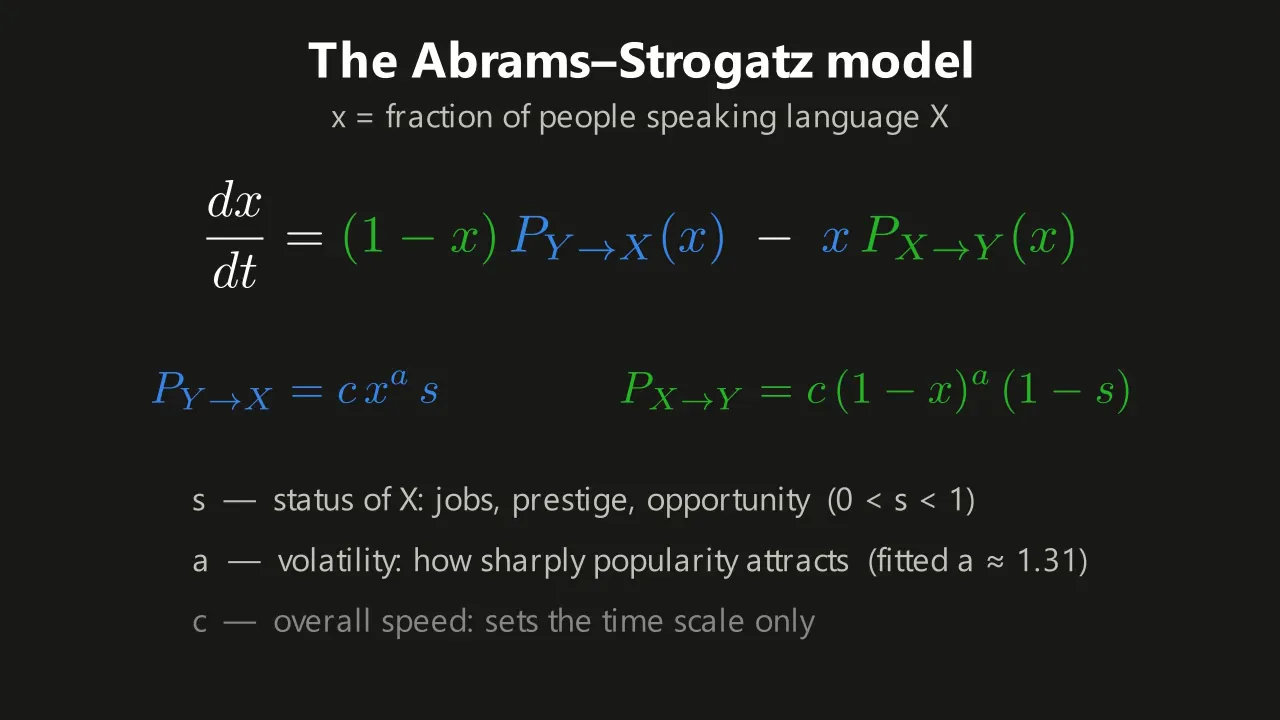
Final project for Modeling and Simulation of Complex Systems, reproducing and extending Abrams & Strogatz, "Modelling the dynamics of language death," Nature 424, 900 (2003).
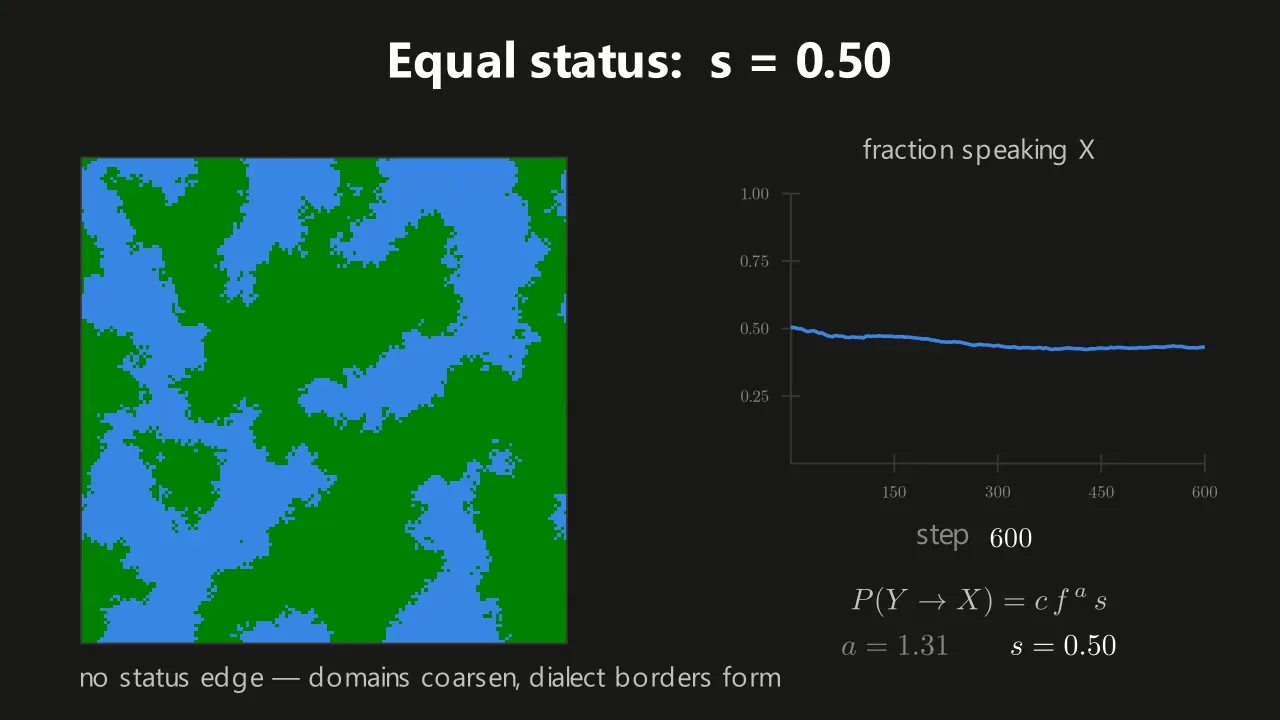
Two languages compete for speakers. The original paper models the fraction of speakers with a single ODE driven by status (s) and volatility (a), and reaches a bleak conclusion: one language always dies. I reproduced that baseline, then extended it into a stochastic cellular automaton on a 150x150 lattice — 22,500 coupled variables, one speaker per site — where the same conversion rule acts on each speaker's local Moore neighborhood instead of the global population.
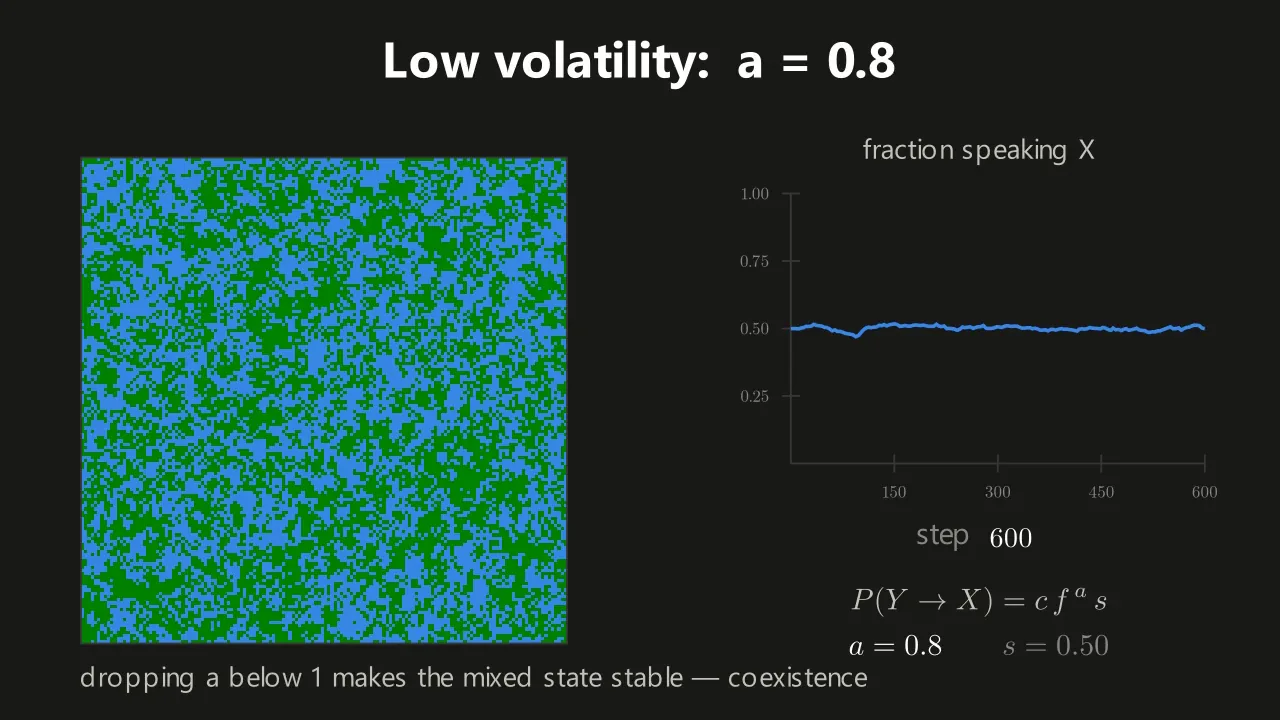
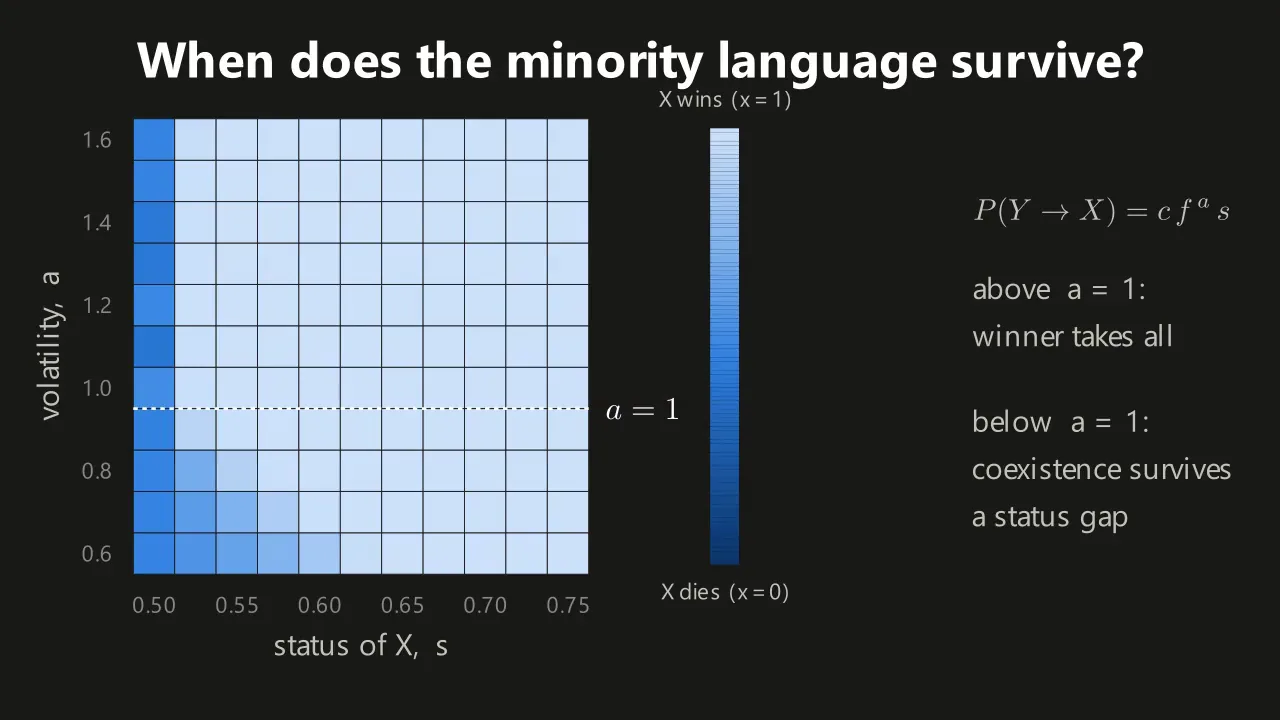
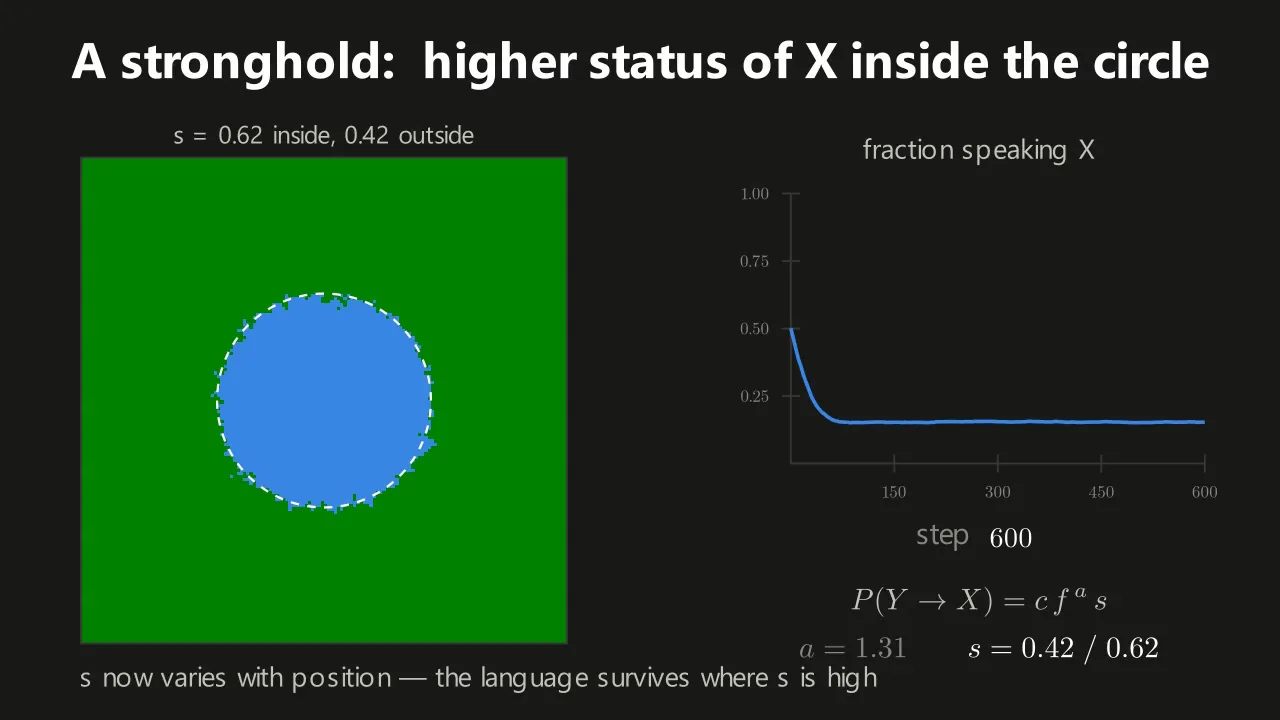
That single substitution changes the ending. Space lets domains coarsen into dialect-like borders, minority languages hold out in strongholds where their status is locally high, and below a volatility of a = 1 the two languages genuinely coexist rather than one going extinct. A parameter sweep over both s and a maps out the full phase diagram of extinction versus coexistence.
Written in Python with NumPy for the simulations and Manim Community for the animated presentation, with every scene rendered directly from the saved simulation data. The repository is currently private.
Gallery